


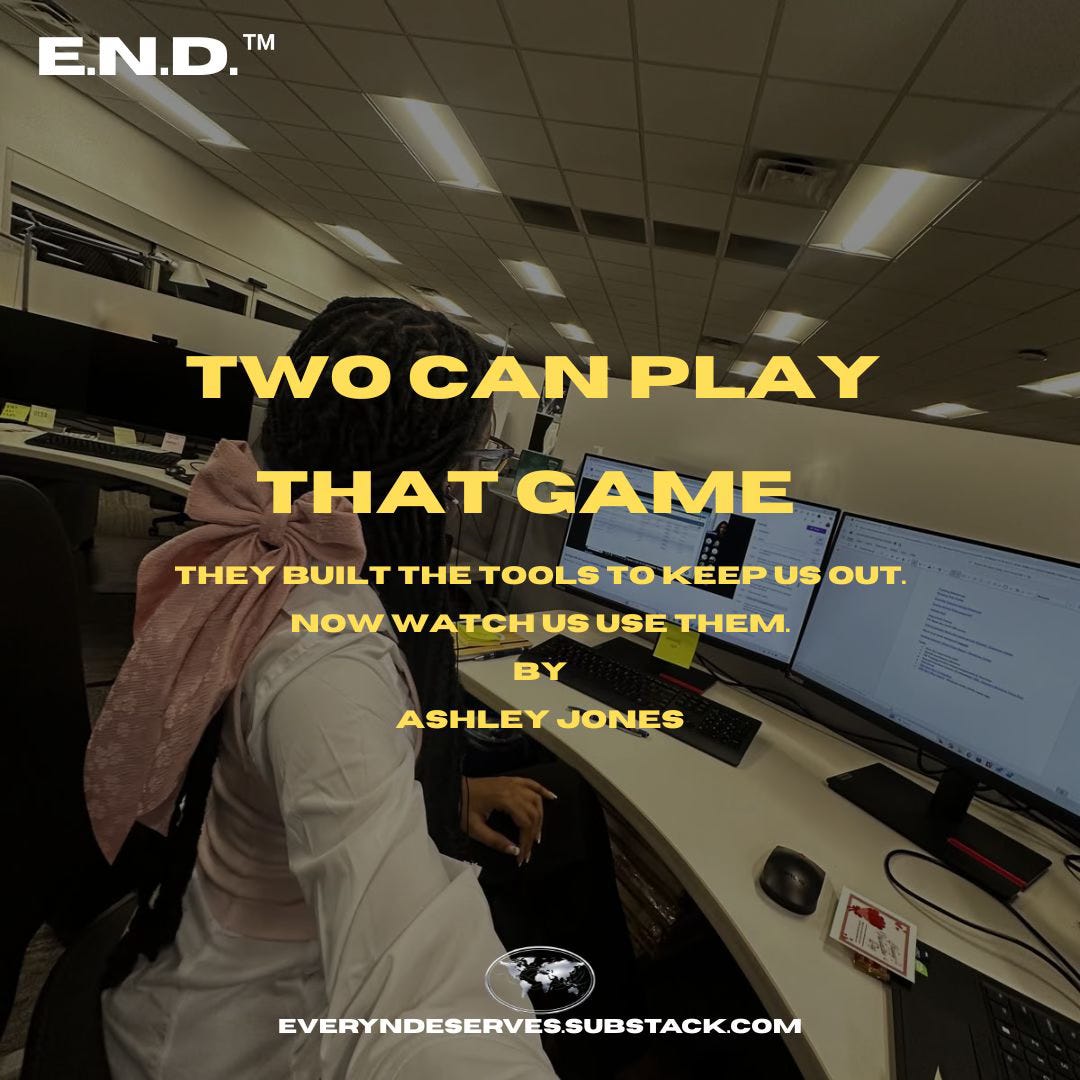
Picture a Black woman at her laptop at 11 PM, refreshing a job portal for a role she is qualified for — overqualified for, if we’re honest. She doesn’t know that an algorithm already decided she wasn’t a fit before a human being ever saw her name. She doesn’t know the model learned what “qualified” looks like from a decade of decisions made by people who didn’t look like her. She just knows the portal says “under review.” She just knows rent is due and groceries are thin.
That’s where this starts. Not in policy language. In a woman at a laptop who deserves an answer she isn’t going to get.
I sit at the corner of business strategy, AI, HR, and operations. I watch how decisions travel — from the White House to the boardroom, to the hiring software, to who gets a job and who doesn’t. People never see that full chain. I do.
Black fluency in how these systems work is becoming one of the most important forms of civic and economic power available to us right now. Not just degrees. The ability to read a jobs report, trace a decision chain, and name what the output reveals about the people who built it. That fluency is what this essay is about — and what happens when we use it.
Trump’s second term is not just speeches. It is federal job cuts that land hardest on Black workers and Black women. Black unemployment has climbed to recession-level rates — rising while white unemployment stays flat. The gap between us is not closing. It is growing, deliberately and measurably, in plain sight.
Corporations are following. They always follow. When the political temperature shifts, when the administration signals that equity commitments are a liability and not a mandate, corporate America reads that signal and moves. DEI programs dissolved. Hiring criteria quietly tightened. AI tools deployed to screen resumes before human eyes ever touch them — tools that courts have now confirmed are screening out Black applicants, older workers, and disabled people at significantly higher rates.
The followers of Trump in corporate — the executives and board members with more than enough privilege and safety to resist — are some of the softest people I’ve ever seen. They surrender their own freedom to avoid discomfort and, in the process, surrender ours.
They are not just taking our jobs. They are taking the next job. And the one after that.
And when the jobs go, the housing goes with them. Trump is holding affordable housing reforms hostage while rents climb in every city where Black people have historically built roots. When you cannot get hired, you cannot pay rent. When you cannot pay rent, you cannot stay.
This is not new. The tools are new. The intent is not.
White supremacy has always moved to contain Black economic freedom. What’s different in 2026 is that the architecture is digital and the discrimination is automated. The algorithm doesn’t need to hate you to exclude you. It just needs to have learned from the people who did.
Here is the part they did not anticipate.
We have access to the same tools. Right now, AI is one of the few contested terrains where the information advantage institutions have always held over us is not yet locked behind a paywall or a policy. We can pull the same data. We can read the Workday lawsuits and the unemployment reports and the housing policy documents. We can form educated opinions about what is happening and build arguments they cannot dismiss.
Someone is doing that research right now. Someone is pulling the data at midnight, building the argument, writing the essay, founding the company. Not waiting for permission. Moving with information — because once you have it, they cannot take it back.
Maybe it’s you. Maybe it’s the woman at the laptop at 11 PM — who doesn’t yet know that the same tools being used against her can be turned around.
We are not backing down about Black unemployment. We are not backing down about the housing crisis. We are not backing down about any of it.
They are counting on our exhaustion. They have always counted on our exhaustion.
We have survived everything they have thrown at us. We are still here. We are still building. We are still watching, documenting, and naming what we see.
They will keep trying. The only question is what we do with what we know.
Ashley E. Jones is a strategist and writer based in Chicago, working at the intersection of AI, HR, and business operations. She is the founder of Sovereign Made LLC and the author of Sovereign Cipher on Substack.
By subscribing, you are directly investing in Black writers, Black ideas, and the future of independent Black media. Every membership helps us commission stories, platform new voices, and continue building E.N.D. into a living hub for revolutionary thought, culture, education, and community.
Thank you for helping us build something that belongs to us.
This is a tough read for me especially now. I’ve moved back home (TX) after finishing a Masters in Chemistry and I am struggling to find a job. I’ve applied to a range of them too— and it’s the exact same blueprint: overqualified, under review, etc..
I can relate to this, to a degree. I’ve always said the system uses us — so two can play that game. I learned to work smart, not hard (or create smart, not work hard), because if they’re going to run these games, I’m going to make them work for me instead.
Funny enough, before I moved to Mexico four years ago, I used to put “white” on job applications, half as a joke, half on purpose. Not because I thought it’d get me into some fancy New York job, but because I knew exactly what the filter was looking for. Then I’d walk in, they’d see I was actually overqualified, and, BOOM hired. Thank you very much 💯 Two can play that game, indeed.