

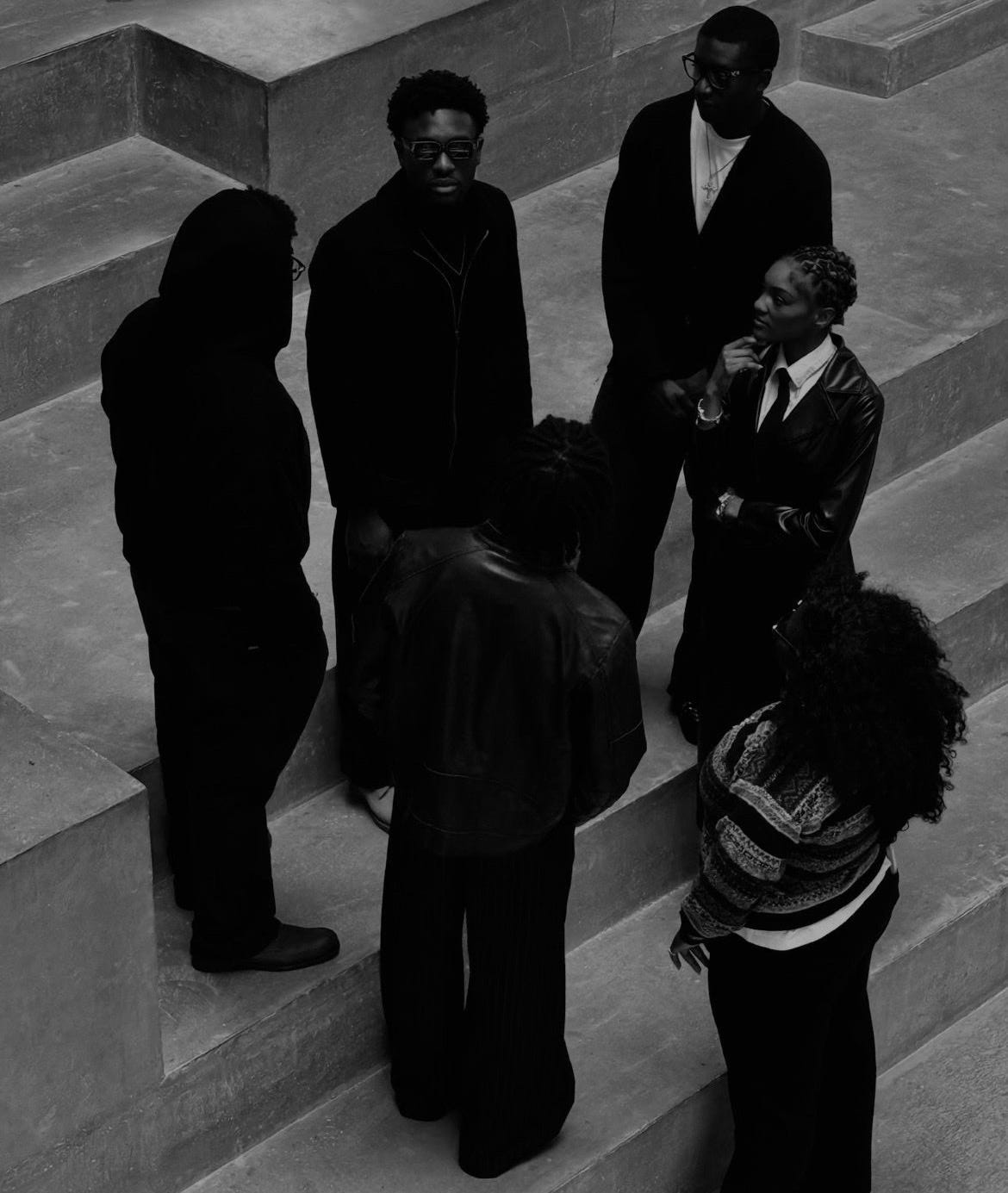
Thursday, October 1st, was a rainy night in Chicago. Still, a room full of us came out for the opening night of the Grits & Eggs Coming Thru America Tour with my brother Deanté Kyle and Big “Ice Cup” Kat. You can catch the podcast anywhere, but the in person experience transcended the mic.
We had a time. Folks were laughing before the punchline even landed. The call and response came without anybody rehearsing it. A whole crowd heard the same words and caught the same meaning underneath them. Like the way family catches your mama’s look across a room full of company while everybody else misses it.
That telepathic communication, the understanding of what’s underneath, is the main thing we have right now. Black people have always known how to read what systems fail to understand. We’ve had to. And as artificial intelligence moves into every corner of how we work and live, that knowledge is about to matter more than it ever has.
In Frederick Douglass’ book 1845 Narrative, he wrote about the songs enslaved people sang in the fields of Maryland. White listeners heard noise, and some convinced themselves they were hearing contentment. Douglass said that while he was enslaved, he couldn’t fully grasp the songs’ meaning himself, because he was “within the circle.” Only later did he understand that every tone carried grief, prayer, and testimony against slavery. The songs said one thing to the people in power and something else entirely to the people who knew how to listen.
That’s what a cipher is.
The word means “zero” in Arabic and later came to mean “a secret code.” In our communities it took on a third meaning: the circle where we gather, build, and pass knowledge to each other. A people counted as zero, as nothing worth paying close attention to, learned to make language that carried more than one message at a time.
W.E.B. Du Bois named the other side of that skill double consciousness, the experience of always seeing yourself through the eyes of a world that looks at you with contempt. He described it as a burden, and it is. But it also trained us to read two rooms at once. We learned to hear what a person says and what they actually mean, to check the official story against what we saw with our own eyes, and to know when a policy, a smile, or a promise doesn’t mean what it claims.
That training isn’t limited to one class of Black people. If you work a call center, drive a CDL, carry the mail, sling fries, or sling finance reports on the 40th floor, you know how to read a boss and a system that wasn’t built with you in mind. Different jobs, same language.
Now AI is arriving at all of those jobs. It’s scheduling workers, tracking them, rating them, and in some places doing the work itself. The office and front-desk work that brought so many of us into professional buildings is projected by the federal government to keep shrinking over the next decade, and Black workers hold about 15 percent of those jobs. So the question isn’t abstract.
Who’s going to make sure we still own something when the machine shows up at our job?
The machine has a problem reading us. That’s where our skill becomes essential.
In 2024, a team of researchers published a study in Nature testing popular AI language models. When they asked the models about Black people directly, the answers came back polite. Then they gave the models the same statements written two ways, one in standard English and one in African American English (AAVE), the English so many of us grew up speaking at home. The models attached the harshest stereotypes to the second speaker, matched them to lower-prestige jobs, and in hypothetical court cases were more likely to convict them and more likely to recommend the death penalty. Nobody typed the word Black.
The machine heard how we talk and decided who we were.
The study also found that the training meant to make these systems sound less offensive did little to fix the prejudice underneath. It mostly made the surface more polite.
That should sound familiar. It’s the same gap our people have always had to read, between what an institution says out loud and what it actually decides. The machine can read our words, and it still reads us wrong. For anyone who has spent a lifetime noticing the distance between polished language and real outcomes, that gap isn’t a mystery. It’s home territory.
We are exactly the people who should be checking these systems, because we already know what it looks like when something sounds fair and isn’t.
This matters outside of just our jobs.
In 2019, the Senate Intelligence Committee reported that the Russian disinformation campaign around the 2016 election targeted Black Americans more than any other group, using fake pages and accounts built to look like they came from inside our community. AI makes that kind of operation faster and cheaper to run. And the oldest thing these systems sell us is fear. For generations it came dressed as respectability: shrink yourself, keep your voice down, don’t speak up for yourself or anybody else, or you’ll lose your job. Other folks get chance after chance after chance, while we get one and are expected to be grateful for the breadcrumbs.
Now the fear has a new costume. AI is new and unknown, so wait. Let someone else learn it first and come back to teach you. Underneath that advice is the same old belief that they’re smarter than us, and the lie detector determined that was a lie a long time ago.
The truth is that nobody has a head start on this technology.
It’s a machine, and you decide what it does. You keep your hands on the wheel. Ask it where it got its information. Ask the same question a different way and see if the story changes. Make it show its work, the same way you’d handle anybody you caught in a lie. We’ve been fact-checking confident people for four hundred years.
We also know what to do with knowledge once we have it. Historian Albert Raboteau documented how enslaved people slipped away to worship in secret, in woods and ravines they called hush harbors, where they could speak freely out of the overseer’s hearing.
That’s the cipher with a body: people in a circle, saying what couldn’t be said anywhere else and carrying it back out together. Deanté and Kat say it on Grits & Eggs all the time: the revolution is love. To love somebody means knowing when they’ve reached their limit and knowing how to show up for them next time.
So use AI the way our people have always used whatever tools they had. Let it find the Black-owned spot, plan the meetup, and get the word out. Then get off the screen and get in the room. Fill up our businesses and have the conversation out loud, among our own. Pool what you learn and teach it back. Teach the little girl on your block to question the machine before anybody teaches her to obey it.
We are the originators and the blueprint, the ones who know how to get it started and how to make this shit shake, and that’s exactly what they come harvesting every chance they get.
The world has always counted us as zero, nothing worth reading closely. That mistake is part of what kept us alive. They never learned to read us, and we learned to read everything. If you understood this, you’re already in the cipher. Now get in the room, like that rainy Thursday in Chicago, where everybody heard the same words and caught the same meaning underneath, together.
Ashley E. Jones is a Chicago-based strategist and writer, the founder of Sovereign Made LLC, and the author of Sovereign Cipher; find her on Substack at substack.com/@sovereigncipher and on LinkedIn at linkedin.com/in/ashleyerinjones
For just $5 a month, you’re directly investing in Black writers, Black ideas, and the future of independent Black media. Every subscription helps us commission original stories, platform new voices, and continue building E.N.D. into a living hub for revolutionary thought, culture, education, and community.
Thank you for helping us build something that belongs to us.
This part right here is blowing me- “In 2019, the Senate Intelligence Committee reported that the Russian disinformation campaign around the 2016 election targeted Black Americans more than any other group, using fake pages and accounts built to look like they came from inside our community.” 🤯🤯
The revolution is a conversation which can never be silenced because it underscores everything.