
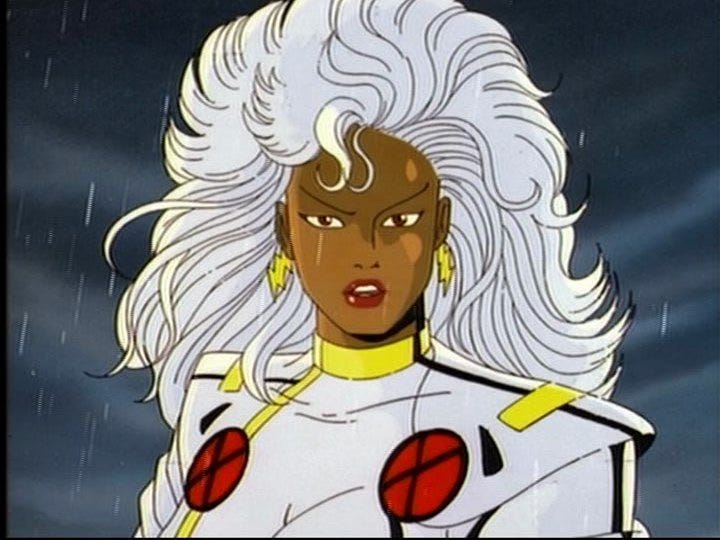
On September 9th, 1995. I’m in suburban southern Connecticut. A precocious, lonesome young boy. Even though I’m not yet five, I already have too many flaws: too bookish, too effeminate.
Finally, it’s time.
In the X-Men: The Animated Series episode “One Man’s Worth”, members of the superhero activist team travel through time and land in the Jim Crow South. When confronted by locals angered by the appearance of interracial marriage, Alison Sealy-Smith says: “Skin color prejudice? That’s so pathetic, it’s almost quaint.” Her tone: haughty, indignant, defiant, elegant, and fearless, was everything! Everything I knew I’d need to become to survive, emotionally stranded in a world unprepared to accept my humanity.
She was Storm.
Every Saturday morning, images of Storm expanded my imagination and concept of self. In a way that felt taboo, she let me reimagine power, without the conventional Black masculinity I had already been violently disqualified from.
Growing up in the 1990s made being a Foundational Black American feel like a party. Our culture enjoyed an enormous amount of influence across movies, television, music, and fashion. This was the time of an expanding middle class and the first generation of Hollywood creatives culturally removed from systemic segregation. Blackness was portrayed as unapologetically cool, successful, desirable, and above all, marketable.
While the world was learning to see Black humanity more fully, I was learning that not all of us were included in the vision.
In the public consciousness, the Black American man was suave, handsome, athletic, talented, funny, and deceptively churchgoing. His image sold tickets, records, fragrances, or sneakers. Denzel Washington. Tupac Shakur. Michael Jordan. Masculine and tough. Not. Soft.
Heterosexuality and conventional masculinity were mandatory. The increasing popularity of gangsta rap made explicit expressions of misogyny and homophobia an inescapable daily reality. At school, I felt the constant sting of alienation, marked and excluded by peers who’d comfortably internalized the limits of socially-acceptable Black masculinity. Already, they’d begun to enforce its rules of engagement. But every Saturday morning, a Storm appeared, offering an escape from society’s restrictions. I had freedom.
I didn’t yet understand that I’d been perpetuating another stereotype: borrowing emotional safety from a Black woman. I used her freedom to imagine a way out of my own constraints, without understanding how the Black women around me were often denied that same freedom; punished by forces outside their control.
In the early 1970s, Marvel Comics sought to revive the X-Men series, this time with a new, internationally diverse cast of characters. When she debuted in 1975’s Giant Size X-Men #1, Storm became the first Black female superhero in mainstream American comics, leading the X-Men and becoming a complex character study in femininity, authority, and self-determination.
Storm rejected pop culture’s sassy, subservient stereotypes of Black women. She was graceful, regal, otherworldly beautiful, completely in control of her emotions, and undiminished by the daily burdens of anti-Blackness. In other words, a power fantasy, like the ones white boys had already been afforded in characters like Batman and Spider-Man, white girls in Wonder Woman and Supergirl, and increasingly, Black boys, in Black Panther and Green Lantern John Stewart.
Storm showed the world that Black girls were powerful, beautiful, authoritative, and extraordinary, that they could be those things without having to sacrifice their authenticity.
But I was not a Black girl. I was a Black boy, wrestling with the contradiction of my admiration.
I knew I related to Storm. I knew I wanted to be like her. Not because she was a woman, but because she represented a model of Black power that wasn’t contingent on being masculine in all the ways I already wasn’t. Relating to Storm didn’t make me less of a boy. It made the possibilities within my version of boyhood more expansive.
When FOX Studios was casting 2000’s X-Men, the role of Storm was reportedly offered to Angela Bassett before going to Halle Berry. With the cultural specificity that made the character compelling stripped away, what remained was a light-skinned, Eurocentric vision of Black beauty representing a character that had formerly stood for fully realized Black womanhood.
The implication was that Storm was better seen than heard, better light than dark, better subordinate than leading, and that the racial politics of Marvel’s first Black female superhero were suddenly up for debate.
Where was the character whose protection had carried me through such a tumultuous early life? In many ways, I could no longer recognize her.
By the time Alexandra Shipp was cast as the younger version of Storm for 2016’s X-Men: Apocalypse, the cultural conversation had changed, and social media backlash was swift. Consistent questions about colorism, proximity to whiteness, and the erasure of dark-skinned women from mainstream media followed the film’s release. Shipp herself responded to the criticism, telling Andscape: “I was thinking…all of these people are trying to tell me how Black I am…no one can tell you how Black you are…I’ve never been treated like a white girl.”
She would reprise the role in 2019’s Dark Phoenix, but like her predecessor did not feature prominently in either film.
For what it’s worth, neither Halle Berry nor Alexandra Shipp made Storm less Black, and neither should be made to answer for the decisions of studio executives. Both starred in films disinterested in developing the character into anything more closely resembling her comic book counterpart, seeding a cultural mistrust that mutated into a fiery combination of suspicion and protectiveness regarding adaptations of the character.
To cast Storm in 2026 is to face an incredible amount of public pressure, because she isn’t just a character. She’s also a symbol and a concept; the embodiment of a perfect society we’re still striving toward.
To properly embody Ororo Munroe, aka Storm, an actress would need to be as beautiful as Naomi Campbell, as graceful as Misty Copeland, and as cool as Rihanna. Women like Cynthia Erivo and Chloe Bailey have publicly expressed interest in playing Storm in the MCU, only to receive intense backlash on social media. This one’s not pretty enough. That one’s not tall enough. This one’s too light. That one’s too dark. This one’s too American. That one’s too African.
At what point does protecting Storm’s legacy become just another way to police Black women into meeting impossible standards?
I understand the protectiveness and the fear. Storm isn’t just a character. She’s part of the emotional architecture of my inner self, a barrier that once stood between the world and me. I want the next generation of children, Black, queer, or otherwise, to see and feel what I did watching her scoff at skin color prejudice back in 1995. I want the perfect world she represents. I want my Storm.
In August 2026, Marvel broke the internet, announcing initial castings for its upcoming X-Men film. Among them was Maya Boyd, a 23-year-old Broadway actress from Ann Arbor, Michigan, as Storm. Immediately, social media began to buzz. She’s beautiful, but is she dark enough? Tall enough? Does her voice sound regal enough? Does she affirm my idealized image of Black womanhood?
Does it matter? Well, yes! But not in the way you might think. “It matters” is a lot different than “it has to be the way I want it,” and that’s a distinction that’s easy to miss.
Storm has survived over 50 years of publication history in part because she’s not just one thing, defined by one person. She belongs to the artists who design her, the writers who interpret her, the actors who portray her, the fans who idolize her, and the children who look to her for protection.
The 5-year-old me saw Storm as perfect. Perfection was the only way I could imagine navigating a world that hated and feared me as gracefully as she did.
30 years later, I know better.
Black women, fictional or otherwise, don’t exist to fulfill our fantasies. They don’t owe us perfection, even if they’ve helped us visualize it, against all odds. Storm doesn’t need to be perfect. She just needs to exist, unapologetically. And she does.
Maya Boyd doesn’t deserve to inherit the burden of becoming the Storm who saved me. She deserves the freedom to interpret her own Storm, her own way. Ask yourself what it means to release a woman from your expectations of her, and let’s find out together — on opening night.
Writer Biography: David Daniels IV is a writer, talent strategist, and cultural commentator exploring the intersections of identity, workplace politics, and popular culture. He is the founder of DD4 Consulting, a People Operations consultancy, and the creator of DD4 at Work, where he writes about how work really works. His writing examines the ways culture, power, and representation shape our understanding of ourselves and each other.
Substack: dd4atwork.substack.com
Instagram: dd4_consulting
For just $5 a month, you’re directly investing in Black writers, Black ideas, and the future of independent Black media. Every subscription helps us commission original stories, platform new voices, and continue building E.N.D. into a living hub for revolutionary thought, culture, education, and community.
Thank you for helping us build something that belongs to us.
I have a complicated relationship with Storm. On one hand, I admire her as the baddest baddie of all the X-men heroines and I recognize her cultural importance as one of the first leading Black woman superheroes in mainstream comics. On the other hand, I am perpetually concerned and usually disappointed with almost all of her on-screen adaptations. After years of different live action and animated depictions of Storm, it feels damn near deliberate that not a single one is dark-skinned or has coily textured hair. (Storm with a cloud afro is a gorgeous eye-catching design that writes itself! C'mon!) No, this is not the responsibility of the actresses, but WHO gets casted is a more than valid critique of the executives of each respective project.
Additionally, although I love Storm, as a Black woman, I don't find her to be relatable in most adaptations. Other X-men characters have flaws, get character development, and have on-screen stories lines centering primarily around them, their goals, struggles, and growth. Think about the level of care that has gone into writing characters like Professor X, Wolverine, Magneto, Cyclops, Jean Grey, Rogue, and others. Storm however is practically a goddess. She exists in static perfection (while also simultaneously being suspiciously less powerful on screen than her comic counterpart). Every time Storm opens her mouth (especially in the 90s show and X-men '97) it's like she's giving a speech to the audience rather than just talking naturally and experiencing her emotions. I feel like Storm being elevated to this symbol of regal Black womanhood robs her of her relatability to audiences. On teams, she is distinctly the "other" or the "exotic" one rather than the "just like me" type of character. We're not encouraged to put ourselves in Storm's shoes. This is a greater problem with the writing of Black female characters in general, who were only allowed to be supporting cast members that fell into recognizable stereotypes for such a long time.
I know many of my complicated feelings towards how Storm is depicted are because there are so few Black women superheroes that the weight of getting ideal representation is disproportionately piled onto the few characters we have.
⚡️⚡️⚡️