

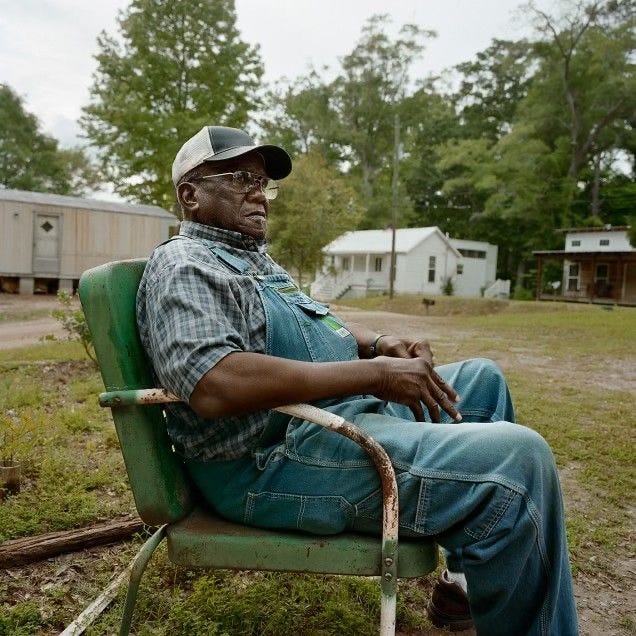
A society reveals its values long before it reveals its politics. It reveals them in the lives of the people who spent decades doing everything they were told would matter, only to discover that dignity in old age is not guaranteed. I didn’t arrive at that conclusion by studying housing policy. I arrived there sitting beside an eighty-something-year-old man searching for an affordable apartment and realized his story was also part of America’s story.
His name was Mr. Jackson. Looking back now, I realize he represented far more than the elderly family friend I knew growing up. He belonged to a generation of Black Americans whose lives were shaped by the opportunities they were given, and the ones they were denied. At the time, I didn’t fully understand that. I only knew him as dependable, caring, hard-working, and knowledgeable on just about any subject.
Mr. Jackson had a compassionate heart for people who were struggling, especially women raising children on their own. If a mother needed work, he found a way to help. Sometimes that meant giving them a job. Other times, it meant introducing them to someone who was hiring or quietly putting a little money in their pocket to get them through the week, never asking for anything in return. If someone was hungry, he fed them. There were meals I ate because of Mr. Jackson. As a young boy, I didn’t think much about where they came from. I just knew that whenever he was around, people seemed a little less burdened. He believed that if you had the ability to help someone, then that is what you did. It was your responsibility.
Looking back now, I realize I admired Mr. Jackson long before I understood what he represented. As a child, I only knew him as someone who showed up for people. As an adult, I began to see that his generosity existed alongside a housing system that had never fully rewarded the very communities that helped build this country. Helping him search for a home would eventually force those two realities into the same room.
Mr. Jackson spent most of his career as a property manager for several apartment buildings in upper Northwest Washington, D.C. He knew leases, inspections, maintenance schedules, tenant complaints, occupancy reports, and hundreds of invisible details required to run an apartment building. He devoted his professional life to making sure other people had a solid place to call home. Neither of us could have imagined that now, in his eighties, he would struggle to find one of his own.
Taking on the mantle of helping those in need, I offered to help Mr. Jackson search for affordable senior housing. I assumed we’d spend a few afternoons comparing communities, filling out applications, and choosing the one that fit him best, and then I’d go on my merry way. Instead, we spent months navigating waiting lists, income calculations, reverse mortgage paperwork, Medicaid eligibility, asset questions, and apartment communities with no vacancies to offer. Somewhere between the third phone call and the fifth housing directory, I realized we weren’t navigating a complicated system. We were navigating history.
I had started this process believing I was helping an elderly family friend complete paperwork. Instead, I found myself confronting the accumulated consequences of decades of housing policy, economic inequality, and decisions made long before either of us picked up the first application. Mr. Jackson wasn’t an exception to the system. He was evidence of it.
In many parts of the country, older adults wait years for an affordable senior apartment, and in some communities, waiting lists are so long they are closed altogether. Mr. Jackson wasn’t looking for luxury. He wasn’t asking for a penthouse overlooking the city where he had spent his career. He wanted what most people hope for after a lifetime of work: a safe apartment, a working elevator, neighbors who might notice if they hadn’t seen him in a few days, and enough money left each month to live.
He managed buildings where families started over. He hired people who simply needed someone to give them a chance. He fed children who weren’t his own because he understood that hunger doesn’t care whose responsibility it is. And now, the housing system he had spent his life helping sustain seemed unable to make room for him.
As a Black man, I couldn’t help thinking about what housing has always meant in communities of color. For us, a home has never been just a home. It has been the foundation of stability. The place where children learn who they are. The only wealth many families would ever own. The promise that maybe our children could begin life one step ahead instead of two steps behind.
Mr. Jackson belonged to a generation that knew this first-hand something the national conversation often forgets: housing is never just about housing. It is about opportunity and whether America intends to make room for you. He lived through segregation. He witnessed neighborhoods shaped by redlining and discriminatory lending. He watched highways cut through thriving Black communities. He saw families denied opportunities to build wealth based on the color of their skin. Yet he never became cynical. He worked. He served. He helped. He believed that if you lifted one person, you strengthened the entire community.
Watching him search for housing forced me to confront an uncomfortable truth: We often speak of the housing crisis as though it arrived with the latest election, the latest recession, or the latest spike in interest rates. It did not. What we call a housing crisis today is the latest chapter in a much older American story, one written over generations as housing became a primary source of wealth while access to that wealth remained profoundly unequal, particularly for communities of color.
That history belongs to no single political party. Every administration inherits it. Every Congress contributes to it. Every generation decides whether to confront it or postpone it.
The current administration faces those same choices. This month, Congress approved the most significant housing affordability legislation in a generation, legislation intended to expand housing supply and reduce barriers to building more affordable homes. President Trump declined to sign the bill after objecting to unrelated legislation, allowing it to become law without his signature. Whether one agrees with that decision or not, Americans should hope the law succeeds because housing affordability is not a Republican problem or a Democratic problem. It is an American problem. Sitting beside Mr. Jackson, however, those debates felt far less ideological than they did deeply personal.
But the question I kept asking while helping Mr. Jackson wasn’t whether another housing development would be built. It was much simpler: Would any of it matter to him? Would an 80-something-year-old Black man who spent his career managing apartment buildings actually be able to afford one? Nationally, the shortage is staggering. There are only about 35 affordable and available rental homes for every 100 extremely low-income renter households, leaving millions of older adults competing for housing that simply does not exist. That, to me, is the real test of housing policy. Not the number of units announced at a press conference. Not the number of campaign promises fulfilled. The real measure is whether people like Mr. Jackson experience a different reality because those policies exist.
I’ve spent much of my professional life working alongside organizations that help families move toward economic stability. I’ve sat in rooms where experts discussed housing, energy costs, transportation, employment, food security, healthcare, and poverty as separate issues, each assigned to its own program, funding stream, or agency. Then I’d leave those meetings and spend time helping Mr. Jackson.
Real life doesn’t separate those problems. The people living these realities don’t experience government one program at a time. They experience it all at once. A housing problem becomes a healthcare problem. A transportation problem becomes an employment problem. An energy bill becomes a choice between medication and groceries. The categories we create to administer assistance often bear little resemblance to how people actually experience hardship.
That’s why I believe every administration must think bigger than housing construction alone. We need more housing. We also need housing people can afford. Building more homes is necessary. But the success of housing policy cannot be measured by construction alone. It must also be measured by whether the people whose labor built our communities can still afford to remain in them. We need neighborhoods where seniors can age safely and systems people can actually navigate. We need policies that recognize humanity before paperwork.
Perhaps that is why helping Mr. Jackson affected me so deeply. I wasn’t helping an elderly family friend complete applications. I was watching the promises America makes about work, responsibility, and dignity collide with the realities of growing old.
We spend a great deal of time talking about Black youth, Black education, Black health, Black entrepreneurship, and Black incarceration. Those conversations are necessary, but far less often do we ask what growing old looks like for Black Americans who survived segregation, built careers, paid taxes, strengthened neighborhoods, raised families, and now find themselves struggling to remain in the communities they helped sustain.
In Washington, D.C., where Mr. Jackson spent much of his life managing apartment buildings, nearly 45 percent of renters are housing cost burdened, paying more than they can reasonably afford for housing. Nationwide, millions of older Americans face the same reality, and Black seniors are disproportionately affected because of decades of unequal access to homeownership, wealth building, and retirement security.
Helping Mr. Jackson made me realize that conversations about housing often begin too late. By the time someone is searching for an affordable apartment, the crisis has usually been unfolding quietly for years. The waiting list is simply the place where decades of public policy finally become personal.
One afternoon, after another round of phone calls that led nowhere, I looked over at Mr. Jackson. He wasn’t angry or complaining. He was tired. For the first time in my life, I wasn’t looking at the man who fed hungry children, found jobs for struggling mothers, debated politics over the evening news, or proudly admired every classic car and motorcycle that passed by. I was looking at an elder who had spent a lifetime giving more than he took and asking for very little in return. History was no longer confined to textbooks or documentaries. It was sitting beside me, tired after another day of searching for a place to live. Until then, I had always thought of history as something that happened behind us. Sitting beside Mr. Jackson, I realized history doesn’t end when the laws change or the headlines move on. It follows people into retirement. It shapes what they inherit, what they can afford, and whether a lifetime of work is enough to grow old with security.
Mr. Jackson loved talking about politics. If given the opportunity, he’d probably debate every policy proposal coming from Washington. He’d certainly have opinions about what President Trump is doing right, what he’s getting wrong, and what Congress ought to do next. Then he’d probably ask a simpler question: “When are they going to do something that actually helps people?” I think that’s the question all of us should be asking.
The measure of a housing policy isn’t whether it wins the next election. It’s whether it changes the life of the person who has spent months waiting for a safe place to live. The measure of a nation isn’t found in the height of its skyline or the strength of its economy. It is found in whether the people who spent their lives building our communities can afford to remain in them.
The irony never escapes me. Here was a man who had spent decades opening doors for other people, sometimes literally. For most of his life, Mr. Jackson held the keys. He unlocked apartments for newlyweds. Single mothers. Families trying again. Men coming home from work. Children running through hallways that smelled like fresh paint and Pine-Sol. He made sure the lights worked, the boilers ran, and the locks latched. He understood that a home wasn’t just a building. It was where life happened. Now, in his eighties, he was waiting for someone to hand him a key.
By subscribing, you are directly investing in Black writers, Black ideas, and the future of independent Black media. Every membership helps us commission stories, platform new voices, and continue building E.N.D. into a living hub for revolutionary thought, culture, education, and community.
Thank you for helping us build something that belongs to us.
Wow moving heart warming story. I pray that when it was all said and done he gotten the help he struggled to receive. We living in a time where every situation requires and advocate. Homeless shelters,mental health, seniors.
Need a job every part of human society needs advocates for housing help.misplace veterans need phycologist also for placement in housing. When you spent a life time helping others. Your heartfelt message is clearly written. Personally known people faced with these issues. I hope he has found a great home.