
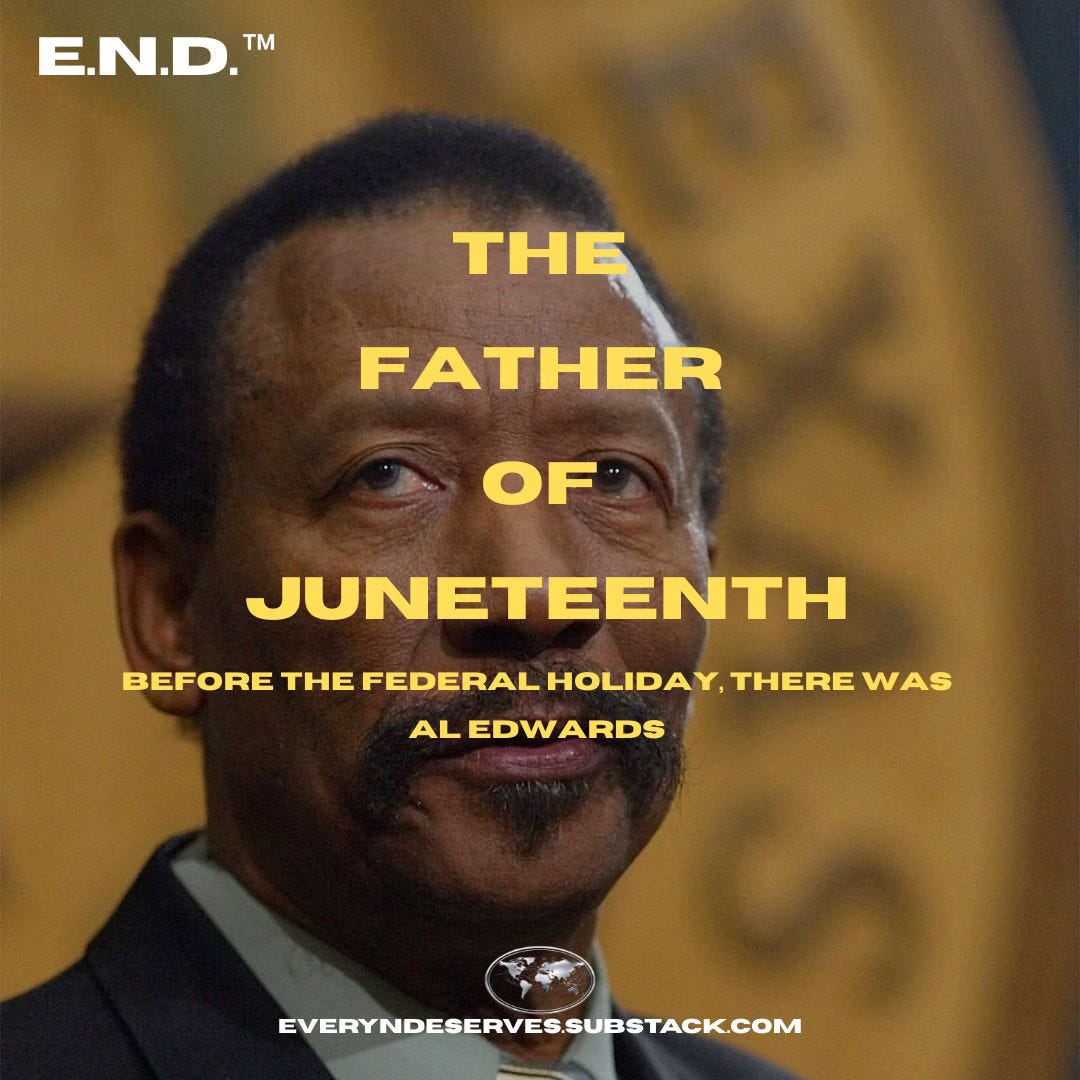
Every year around June 19th, America remembers.
Or at least it tries to.
There are festivals. Cookouts. Family reunions. Corporate campaigns. Social media posts. Politicians giving speeches about freedom. More and more people know that Juneteenth marks the day enslaved Black people in Texas learned they were free.
But memory is a funny thing.
We often celebrate the thing while forgetting the people who fought to preserve it.
And when it comes to Juneteenth, few people planted more seeds than Representative Al Edwards.
Long before Juneteenth became a federal holiday.
Long before companies “discovered it.”
Long before politicians competed to be photographed at celebrations.
There was Al Edwards.
A Black man from Houston’s Fifth Ward who believed that the story of Black freedom deserved more than a footnote in American history.
He believed it deserved a holiday. Not because it was popular.
Because it was true.
Juneteenth commemorates June 19, 1865, the day Union General Gordon Granger arrived in Galveston, Texas and announced that enslaved Black people were free. More than two years had passed since President Abraham Lincoln signed the Emancipation Proclamation.
Freedom had been declared. But for many Black people in Texas, freedom had not yet arrived.
That reality sits at the heart of Juneteenth.
It is a celebration of liberation, but it is also a reminder. A reminder that justice delayed is still injustice.
A reminder that freedom on paper and freedom in practice are not always the same thing.
A reminder that progress often arrives later than it should.
For generations, Black Texans carried that memory forward. Families gathered in parks. Churches hosted celebrations. Elders told stories. Communities remembered.
They did the work of preserving history even when much of the country wasn’t paying attention.
One of those Texans was Al Edwards.
Born in Houston in 1937, Edwards was one of sixteen children raised by Reverend E.L. Edwards Sr. and Josephine Edwards. Growing up in a large family taught him lessons that would shape the rest of his life: community mattered, responsibility mattered, and the well-being of the collective was larger than any individual.
Those values followed him into adulthood.
He graduated from Phillis Wheatley High School, attended Texas Southern University, and came of age during the Civil Rights Movement. Like many of his generation, he understood that progress was not something handed down from above. It was something people organized, demanded, and fought for.
Politics became another avenue for that work.
When Edwards was elected to the Texas House of Representatives in 1978, he arrived with a mission. He wanted Texas to officially recognize Juneteenth.
Today, that idea may sound obvious. At the time, it wasn’t.
Many people viewed Juneteenth as a regional tradition rather than an event worthy of official recognition. Others believed slavery was too far in the past to merit public commemoration. Some questioned whether the effort was worth pursuing at all.
But Edwards understood something many others did not.
History disappears when nobody is willing to defend it.
Memory survives because somebody decides it matters.
So during his first term in office, Edwards authored legislation that would make Texas the first state in America to officially recognize Juneteenth as a state holiday.
The bill passed.
And on January 1, 1980, Texas became the first state to formally honor Juneteenth.
The victory wasn’t accompanied by national headlines. There were no viral moments.
Just years of conviction from a man who believed Black freedom deserved public remembrance.
That kind of devotion is easy to overlook now.
We live in a time when Juneteenth is increasingly visible. What was once celebrated primarily in Black communities across Texas has become a national observance. In 2021, Juneteenth officially became a federal holiday after decades of advocacy from activists, educators, organizers, and community leaders across the country.
People like Opal Lee spent years helping the nation understand why Juneteenth mattered.
People who carried the memory before the country was ready to embrace it.
What makes Edwards remarkable isn’t simply that he won. It’s that he cared before winning was possible.
He loved the story before America loved the story.
He understood that every generation inherits something it did not build and bears responsibility for passing it forward.
Juneteenth was never simply legislation. It was legacy.
Al Edwards was a son, a brother, a father, a legislator, and ultimately a steward of memory.
Today that responsibility lives on through his family, especially his son, Jason Edwards, who continues the mission through Juneteenth USA. Through education, celebration, and preservation, he carries forward the work his father began decades ago, ensuring that future generations understand not only the history of Juneteenth but the responsibility that comes with remembering it.
There is something beautiful about that. Because Juneteenth itself is an inheritance. A story passed from grandparents to grandchildren.
The Edwards family reminds us that remembrance is not a one-time act. It is a responsibility.
Someone still has to teach it. Someone still has to protect it.
And while America rightly celebrates Juneteenth, we should also remember there was a man from Houston who believed Black freedom deserved to be remembered.
Al Edwards walked so the holiday could run.
And today, we each continue the journey.


By subscribing, you are directly investing in Black writers, Black ideas, and the future of independent Black media. Every membership helps us commission stories, platform new voices, and continue building E.N.D. into a living hub for revolutionary thought, culture, education, and community.
Thank you for helping us build something that belongs to us.
it’s so important to honor Mr. Al Edwards during this Juneteenth!!! i didn’t know much about him before this but preserving his legacy is so important to the holiday. i totally agree that upholding memories is a responsibility! 🫶🏾
1937 Produce some great people… to include my grandma