
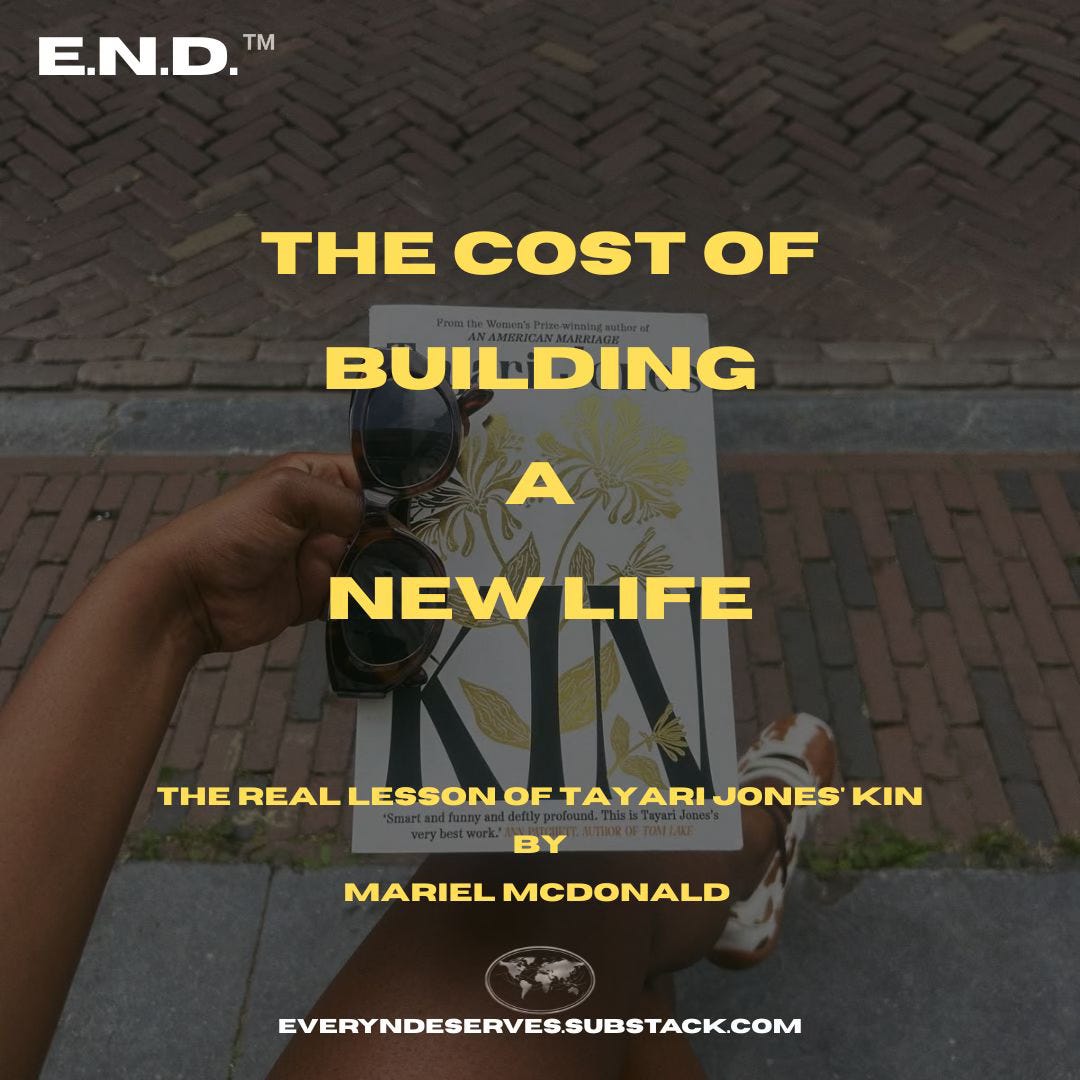
Growth and change are essential aspects of life, as life is just a progression of both caused by the decisions we make based on circumstance. But have you ever thought about what that might look like? Movies make it hopeful and optimistic, but what if after all those decisions and events, you don’t get the “happy ending”? What if that happy ending doesn’t look like what you had hoped and worked so hard for?
Tayari Jones’ new novel, Kin, forced me to ask myself these exact questions. In the book, the two main characters, Annie and Vernice, spend their lives in search of the unconditional love that a mothering figure provides.
Throughout their journeys, they mold their life decisions around that overarching goal of finding motherly love, creating emotional fallout that they must deal with in the process. Both women do however get what they think they want in the end, but what follows after creates emotional turmoil for both.
By the end of the book, they reflect on their choices made to get what they thought they so desperately needed and desired and see all the damage done in the aftermath. The conclusion is quite sad, with them only valuing what they had after it was already gone and questioning whether it was all worth it in the end.
Like Annie and Vernice, sometimes we ignore the journey and are solely focused on the end goal.
“Why am I not there yet? What am I doing wrong?”
I’ve asked myself this question a million times when trying to get publications to take note of my work as a writer. But what I didn’t value (at the time) was all the no’s and unhappy endings I’ve had along the way. The rejections and feedback, both positive and negative, that helped me to become better at what I love to do. The friends and connections made along the way. The progress that it forced me to make.
Sometimes, what’s best for us actually feels like the worst. Change makes us feel uncomfortable because it’s new and we don’t have all the answers. We don’t realize that these changes force us to be an active participant in the journey to the destination.
These changes could look like failing, losing people and opportunities, sacrificing old habits, or in some cases, even giving up on an aspect of said goal.
The danger with Annie and Vernice is that they obsess over the goals of finding nurturing mothers, to their own demise. Vernice loses out on what appears to be unconditional romantic love; while Anne misses out on a true sense of self-understanding and love.
When we pursue goals with our blinders on, sometimes this is the price we pay. That is the lesson; there is always a price to pay when attempting to reach our goals, and only we can
determine if it’s worth it. There are readers who aren’t sad at all by the conclusion, as they attribute it to this very concept. Regardless, life continues and we have to as well.
The key is to keep going and value all that has been accomplished along the way, wins and failures included. Value the people and be thankful for the opportunity to learn from mistakes.
The main characters in Kin were only thankful when viewing the past in hindsight, but as Slim Charles said in The Wire, “The thing about the old days . . . they the old days.”
I am learning to value the present in my own life, realizing that every experience has a purpose. I moved back home post-graduation and was so frustrated with being unable to find work. I was determined to move on and reach my goal of being an independent woman away from family.
When my grandmother was diagnosed with cancer and placed in hospice, I realized that I should have been valuing the opportunity of being around family that living with your parents affords. That was the perspective I missed. I now cherish the time I got to spend with her as well as the rest of the family and am grateful for my “misfortune” of struggling to find my footing after college. Learning that that’s where I was supposed be was my own “growing.”
It’s very easy to get caught up in only focusing on the destination, but what Tayari Jones’ novel taught me is that the goal isn’t the actual goal. It isn’t necessarily a finite, well-defined point in time. It changes as we do. We can hope that we reach that place, but we must consider the decisions we’ve made and experiences we’ve had along the way. These factors can greatly alter what that goal looks like, and that’s okay. They should, as the changes prove we are growing.
When I look back on my own personal journey and life, I want to know and feel confident that it was all worth it. That my decisions and events in the past and present are just as important as the theoretical main event in the future, and each should be valued on their own merits.
By subscribing, you are directly investing in Black writers, Black ideas, and the future of independent Black media. Every membership helps us commission stories, platform new voices, and continue building E.N.D. into a living hub for revolutionary thought, culture, education, and community.
Thank you for helping us build something that belongs to us.