
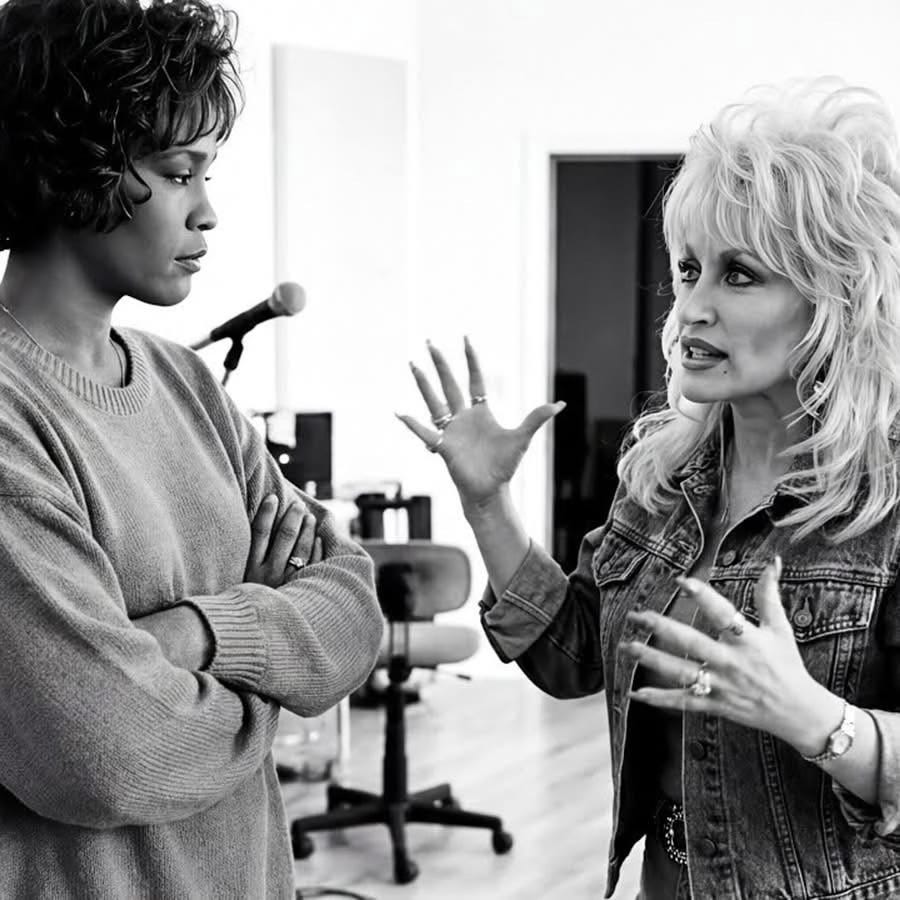
In a house full of women, “I Will Always Love You” was inescapable. It played on radios, televisions, in living rooms, and through car speakers. The adults around me understood the ache of it. At five, I only understood Whitney.
I was captivated by the video, by that red lip, and by that power suit. By the way, the softness in all of that eventually gave way to something enormous. Whitney didn’t need choreography or spectacle. She sat there and sang. Then the clarity and pristine intonation in her voice rose until a song about leaving someone somehow sounded like both devastation and triumph. I didn’t know enough about romantic love to understand why anyone would leave a person they still loved. I just knew something important was happening.
I also had no idea Dolly Parton wrote the song.
There are people who didn’t know“I Will Always Love You” first belonged to Dolly.
Dolly Parton, died on August 25 at 80, and leaves behind the kind of career that is incapable of summarizing. With nearly six decades of music, thousands of songs, Dollywood, movies, rhinestones, philanthropy, and a public persona so magnanimous, she will be missed forever.
As tributes roll in there is another part of her legacy that must be illuminated: her professional relationship with Black women.
Whitney Houston transformed “I Will Always Love You.” More than 30 years later, Beyoncé transformed “Jolene.”
One expanded the sonic possibilities of a Dolly Parton song, and the other rewrote its emotional politics. Both did so inside an American music industry that has spent more than a century pretending its genres developed along tidy racial lines, despite American popular music being fundamentally shaped by Black musical traditions.
Before the music industry figured out how to sell Southern sound, Black and white musicians were already playing traditions that overlapped far more than the categories we inherited suggest. In the 1920s, record companies were marketing music by Black performers as “race records” while rural white musicians were increasingly sold under the category of “hillbilly” music. Sounds that shared geography and influence became separated on store shelves and, eventually, in the American psyche.
Genre did not simply describe American music. It helped teach us to hear it in racial terms.
Parton originally wrote the song as a farewell to Porter Wagoner, the country star whose television show helped introduce her to a national audience. She wanted to end their professional partnership, and when words failed her, she wrote the lyrics instead. Dolly’s recording of the song is conversational and delicate. It sounds like someone trying to have a conversation without waking a sleeping baby.
Whitney came through and sounded all the alarms. The arrangement builds around her until the song reaches the kind of vocal crescendo that made Whitney Houston, THE Whitney Houston. She transformed a modest country ballad into a gospel, soul, R&B, and pop performance in a monumental run where she spent 14 weeks at No. 1 on the Billboard Hot 100 and won Record of the Year at the Grammys
And Dolly was enamored.
It would be easy to flatten this story into one about a benevolent white woman welcoming Black artists into her world. The white-savior trope is too simple, mostly because it erases the choices and genius of the Black women involved. Whitney Houston did not need Dolly’s generosity to make “I Will Always Love You” extraordinary.
But what kind of white woman watches a Black woman take one of the most important songs she has ever written and create a version so culturally enormous that entire generations barely know the song belonged to her first?
Dolly’s decision to allow Whitney to sing her classic record isn’t some form of sainthood. It’s her understanding the difference between ownership and possession.
Years before Whitney recorded “I Will Always Love You,” Elvis Presley wanted to. It was the kind of opportunity most young songwriters could only dream about until his manager, Colonel Tom Parker, informed Parton that Presley’s team expected 50% of the publishing. Dolly refused. She knew her songs were art, but she also understood they were assets. And the assets, Dolly determined, should be shared with a Black woman.
Dolly spent the next three decades publicly celebrating what Nippy had found inside her song. Whitney’s success ultimately earned Dolly so much, Parton later said in a Nashville office complex in a predominantly Black neighborhood. She affectionately called it “the house that Whitney built.”
In a 2022 interview, she then, remarkably, asked for it to happen again.
Parton publicly said she wanted Beyoncé to do something similar with “Jolene.” Dolly wanted another Black woman to take one of her “little songs,” and discover something bigger inside it.
Beyoncé did exactly that.
If Whitney expanded Dolly’s song, Beyoncé argued with one. Dolly’s “Jolene” is built around vulnerability. Its narrator studies another woman’s beauty almost obsessively and begs her not to take the man she loves. There is power in the recording is how Dolly sits lyrically in fear.
Bey’s version of the homewrecking anthem arrives on Cowboy Carter, an album the Houston native said was born from an experience in which she “did not feel welcomed” in the country space. It was a Black Southern woman examining why a musical heritage partially built by people who looked like her had been packaged as though they were outsiders.
On the original track, Dolly pleads. Beyoncé, however, warns. Parton later admitted she expected Beyoncé to sing the traditional version and was surprised by the rewrite. She loved it anyway. “As a songwriter,” she explained, “there was joy in hearing what somebody else could do with your work.”
There is something almost radical in that simplicity when placed against the racial history of American popular music. Black creativity has repeatedly been welcomed before Black creators were, and Black innovation has often become palatable, more profitable, or more “American” once separated from the Black people who made it.
Now Dolly has passed on, and the songs enter another life.
An afterlife that is more expansive than race. Many argue that music is the unifier. Dolly embodied that.
Perhaps that is the eerie negotiation of creating something capable of surviving you.
You can write and own a song. You can protect it fiercely enough to tell Elvis Presley, the alleged King of Rock’N’Roll, no. But once you release it into the world, you cannot possibly know every person who will eventually hear themselves inside it.
Black artists have been finding hidden possibilities within American music for generations, even as the industries surrounding it have tried to tell us which rooms we belong in.
The late Backwoods Barbie simply seemed to understand that neither Whitney’s nor Beyoncé’s greatness required the erasure of hers.
And perhaps that’s the way they will keep living–even if, like me, my 8-year-old will discover at some point that two of the songs I blast during Saturday morning cleaning actually belonged to Dolly Parton first.
Christina Santi (she/her) is a multimedia communications specialist, cultural critic, and creative nonfiction writer whose work explores Black culture, race, gender, power, and the complex intersections between them. She received her MA in Creative Publishing and Critical Journalism from The New School. Her writing has appeared in EBONY Magazine, TriQuarterly, and other publications. When she isn’t writing, editing, or teaching, she’s likely museum hopping with her son or obsessively explaining to someone why Frank Ocean’s music is masterful.
Instagram: Rawrsavvy
Substack: Christina Santi
For just $5 a month, you’re directly investing in Black writers, Black ideas, and the future of independent Black media. Every subscription helps us commission original stories, platform new voices, and continue building E.N.D. into a living hub for revolutionary thought, culture, education, and community.
Thank you for helping us build something that belongs to us.