
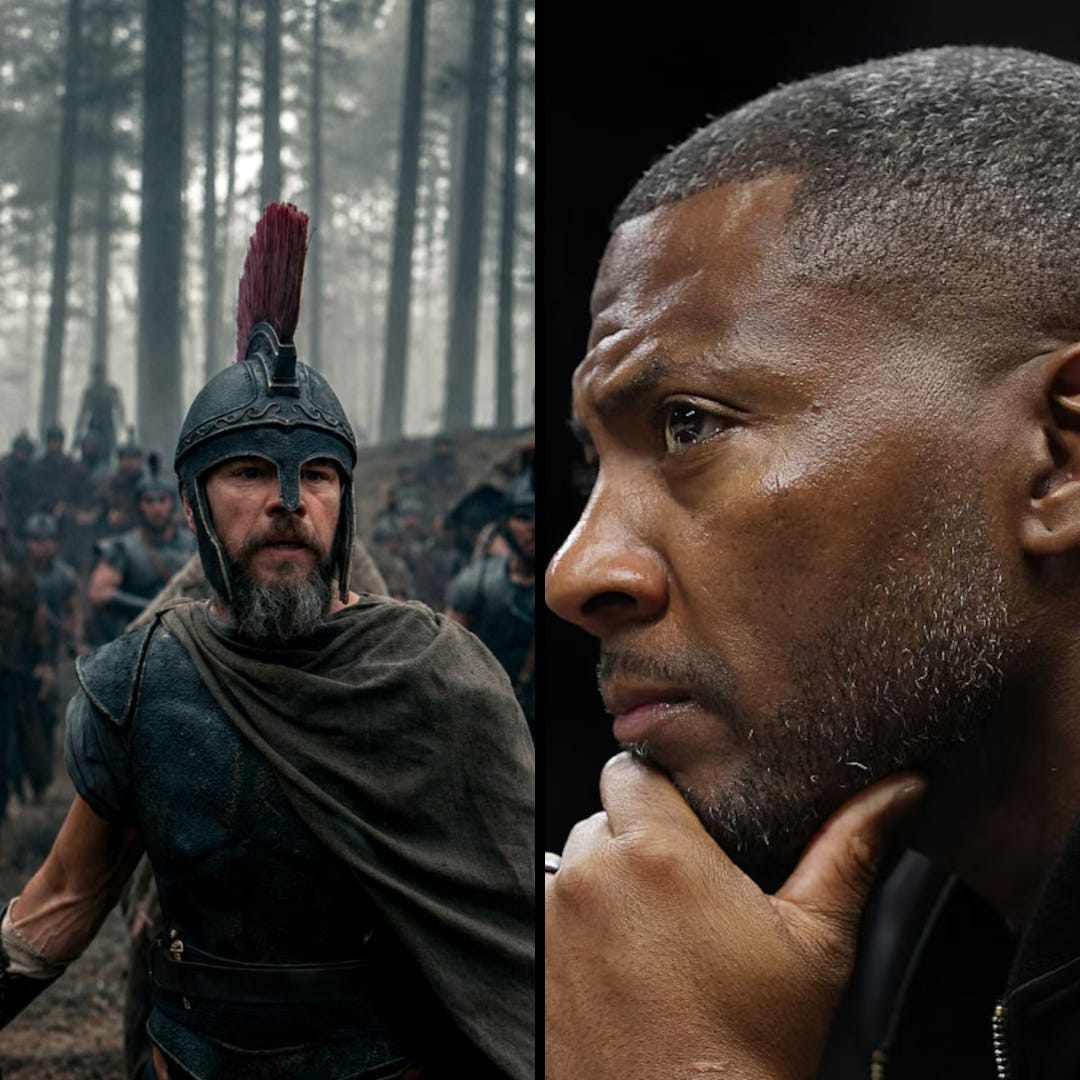
“Auntie, we should go see The Odyssey,” my niece said. “It’s amazing. It’s loud, but I think you’ll love it.”
We went to the late showing. 8:30 at night, three hours long. She’s young enough that staying up for it wasn’t a question. I’m not — these days I’m up by 5:30 whether I want to be or not, which is its own kind of surrender, since I spent most of my life being the person you didn’t speak to in the morning until she spoke to you first. I fully expected to fall asleep somewhere around hour two.
I didn’t. Not once. It was loud, and it was strange, and it was thought-provoking in a way I wasn’t braced for.
The week I first saw The Odyssey was the week ESPN let Ryan Clark go.
Clark is from Marrero, a working-class suburb in Jefferson Parish on the West Bank of the New Orleans area. It is only about five miles from the center of the city, but New Orleans is small enough that crossing the river can be treated like going on a journey. The West Bank is geography, but it is also an identity. It can mean Algiers inside the city limits or Harvey and Marrero beyond them. Clark is not from the city of New Orleans. He is, unmistakably, from the West Bank.
He played at Archbishop Shaw and LSU, went undrafted, then built a thirteen-year NFL career that took him through New York, Washington, and Pittsburgh, where he won a Super Bowl. After football came ESPN.
He had to leave home to become someone home would eventually celebrate.
Odysseus — a soldier trying to get home to Ithaca after ten years fighting the Trojan War — spends another ten years just trying to complete the journey, and distance is not his only problem. Homer’s Odyssey is full of monsters and gods, temptation and loss — sirens, a witch who turns men into swine, a nymph who keeps him seven years on her island. By the time he reaches his own front door, most of the men who sailed with him are dead, and the wife waiting for him needs proof that the man standing there is actually her husband.
When he returns, he enters his own house in disguise. Even some of the people who love him need proof that the man who came back is the man who left.
Sometimes the long way home is not only the road you travel. It is the distance between being from a place and being fully seen by it.
Frankly, I had always wondered how Clark stayed at ESPN as long as he did. Not because he wasn’t good — he has one of the sharpest minds in sports analysis, full stop. But he was never willing to leave the politics out of it, the race out of it, the gender out of it. He’d debate the X’s and O’s and then, in the same breath, tell you plainly what a decision meant for the athlete underneath it. He is also a brilliant man with an impeccable sense of style, which, for a stylish person like me, is not incidental.
He wasn’t the first person like that ESPN has had. Jemele Hill spent twelve years there before she was suspended, pulled from SportsCenter, and eventually left through a contract buyout after a string of political controversies the network decided it no longer wanted attached to its name. She wasn’t fired, exactly. But by the time she went, both sides had more or less agreed the room had gotten too small for her to stay in it comfortably. I had been watching Clark for years and wondering, quietly, when his turn would come.
The Tenuous Welcome
Clark said it plainly after his firing.
He felt he couldn’t be too Black to keep his seat at that table.
That’s the sentence I keep circling back to, because Clark said plainly what I had been watching for years. His voice got more expansive the longer he stayed — more willing to name what he saw, less interested in softening it for the room. And the room, from where I sat, seemed to get smaller around him at the same rate. Not all at once. A degree at a time, a segment at a time, a chyron here, a colleague’s discomfort there.
More than eleven years at ESPN is not proof that ESPN made room for the whole of Ryan Clark. It might be proof of exactly the opposite — of how skillfully a man can navigate a welcome that was never unconditional to begin with. ESPN could use what Clark brought without ever becoming large enough to hold all of him. Staying that long, in a room like that, means learning exactly how much of yourself the water will hold before it pulls you under.
Under Whose Command
Odysseus knows something about that kind of arrangement. After Troy falls, the Greek kings go their separate ways. Odysseus picks his own path, deliberately, after ten years fighting under Agamemnon’s command. He’s done letting someone else’s war dictate his direction.
It doesn’t make the journey easier. It becomes The Odyssey. But it’s his.
Except carving his own path doesn’t free him from the habits the command structure taught him. A prophet warns him plainly that only he will make it home. Odysseus refuses to accept it — insists he’ll bring his men back too. He doesn’t. The sea takes them anyway, one storm and one broken oath at a time, until he’s alone on Calypso’s island — a nymph who will hold him there seven years — with nothing but his own life. Leaving Agamemnon didn’t undo the instinct to carry everyone. He just started carrying them on his own terms, at his own cost.
I keep coming back to a different word than expansive. Clark’s voice didn’t just get bigger the longer he stayed. It got more expensive. Every time he tied a coaching decision to the history that shaped it, every time he wouldn’t let an athlete’s politics get flattened into a stat line, the cost of keeping him on the air went up. Not because the analysis got worse. Because it stopped fitting the narrow job ESPN had actually hired him to do.
I don’t think Clark stayed at ESPN purely to carry other people. That would flatten a decade of a real career into a single motive, and I don’t know his interior life well enough to claim that. What I can say is this: whatever else kept him there, he used the room he had to make more room for people the room routinely misunderstood. By his own account, he was still code-switching in his final year, censoring himself in places, to keep the seat that let him do it at all.
Code-switching isn’t a rare skill some of us reach for under pressure. It’s the thing Black people do every day, all day, just to move safely through rooms that were never built with us in mind.
Trying to Bring Everybody Home
I know something about that particular exhaustion. For over a decade I helped build and run an organization called Brothers Empowered to Teach, working to get more Black men to consider education as a career. Most had already been told, by their own teachers, by people in their own families, that teaching was a terrible career for a man to choose — or told by their own peers that Black men can’t teach and don’t teach. Many hadn’t had a single Black teacher until high school, or college, or ever.
I remember sitting in a room with a well-known teacher recruitment platform, a room with a lot riding on it, and being told plainly that they just didn’t get it. Why would we pay Black men to consider education as a career? Why were we talking to young men whose GPAs were under 3.0?
We weren’t recruiting from the students with the polished résumés and the degrees from the schools whose names made funders comfortable. We were going after the ones who weren’t sure why they were in college in the first place, who nobody had ever told they might be good at this.
People said we were too Black. Too young. Too fly. They questioned the GPAs, the preparation, whether these young men belonged in a classroom at all.
What that recruiter’s room never understood is that the mask-off space was the point. We built the work around hip-hop, around style, around showing up as ourselves on purpose — suits with sneakers, a tennis shoe game that was its own kind of statement — because we needed these young men to look at us and recognize someone they could actually talk to. We called it the Cipher — the place where the masks came off, where we could name what was really affecting the health and the livelihood of Black men without translating it first for a room that wasn’t in it. It was also where we did the harder work: challenging our own fellows to unlearn the deficit thinking, the gender bias, the socioeconomic assumptions that kept them from seeing clearly across difference, including differences among Black folks. Code-switching wasn’t a skill we were teaching. It was the thing we were trying to build a room sturdy enough not to require.
Even then, much of the early belief and investment we needed came from outside New Orleans. We had to take the work to other cities, build relationships elsewhere, and let people beyond home recognize its value before many institutions here treated it as something worth backing. Apparently, even work built specifically for New Orleans sometimes needs a letter of recommendation from somewhere else.
We proved the doubters wrong more than two hundred times over. Nearly seventy percent of the young people who came through our doors stayed in education or youth development for two years or more. Some of them are physicians now, building organizations of their own to get other Black students through medical school.
I stood in rooms for over a decade defending people’s promise before the room was willing to see it. Sometimes it cost me specific things I can name. I was the only woman in leadership for the first five years, which meant every room required proving I belonged twice — once as a leader, once as a woman leading men. I caught heat from both directions. Men who thought I didn’t understand them. Women who thought I defended men too much, made excuses for them I wouldn’t have tolerated anywhere else. Some of that critique was fair. Standing in that tension long enough to name what’s actually there, without pretending it isn’t, is its own kind of exhausting — the kind that doesn’t show up in a two-hundred number or a percentage.
Here’s what I don’t want to do: turn Clark, Odysseus, and myself into three uncomplicated heroes who stood in the gap and nothing else happened. Standing in the gap has a cost, and the cost isn’t always visible from the outside. Sometimes it looks like integrity. Sometimes it’s actually a form of staying too long — mistaking your own endurance for the institution’s growth, telling yourself the room is changing because you’re still in it, when really you’re the one doing all the changing and the room hasn’t moved an inch. Treading water long enough starts to feel like swimming forward, if nobody tells you the shore hasn’t moved.
I left Brothers Empowered to Teach in 2021. I’ve written before that I left knowing integrity and ego could not coexist. I still believe that. What I’ve had less practice saying out loud is how long I stayed inside that particular storm before I let myself see it as one. I told myself the work was too important to walk away from. I told myself the young men coming through our doors needed continuity more than they needed my comfort. Some of that was true. Some of it was the same story Odysseus tells himself with a boat full of men he cannot actually save — that leaving is a kind of failure, that a good captain finds a way to bring everyone home even when the water has already told him otherwise.
The organization closed for good last year. I wasn’t there when it did. I don’t say that with relief, and I don’t say it with innocence either. I say it because I think there’s a version of staying that we mistake for devotion, and it isn’t until much later — sometimes years later, sometimes only when you watch the thing finally come apart from a distance — that you can ask yourself honestly whether you were holding the work up, or whether the work had already stopped being able to hold you?
I don’t know if Clark ever asked himself that question. I’ve had to ask it of myself, more than once, and I don’t always like the answer. What does it cost to keep trying to bring everybody home, long after it’s become clear the storm isn’t going to let you?
Give Yourself to the Sea
On Calypso’s island, Odysseus gets a different lesson than the one about carrying others — this one is about letting go of control entirely. She keeps him there seven years, feeding him the lotus flower so his grief can’t reach him while they build a life together. It isn’t peace, though it looks like it. It’s a hold pattern, and it breaks the moment Zeus’s storm reaches even her — the moment she starts asking Odysseus what he remembers. Memory has to come back before he can leave. She doesn’t release him by pushing him out. She releases him by making him remember why he came. Only then does she tell him: build the raft, and stop trying to command what happens next. Give yourself to the sea. You cannot control your way home. You can only trust it.
That’s the harder lesson, and I don’t think it’s really about Ryan Clark, or even about Odysseus. It’s about anyone who’s ever stayed inside a place, a role, a version of themselves, waiting for permission to leave that no institution was ever going to grant. We keep thinking the ceiling will move if we’re patient enough, skilled enough, careful enough. Sometimes it doesn’t move because it was never going to. Sometimes the only way home is admitting the room has already told you everything it’s going to tell you, and choosing to believe it.
Ryan Clark had already started building before anyone told him to. The Pivot — the podcast and independent platform he built on his own terms — didn’t get built after ESPN let him go. He built it while he was still on their air, still cashing their checks, still doing the calculus every week about how much of himself the room could bear. ESPN didn’t hand him a way home. They just stopped being the institution whose limits he had to negotiate while building something freer beside it.
When Clark spoke about the firing on his own show, he cried while talking about what his career had finally given him at home: acceptance. “When I go home,” he said, “this kid from the West Bank is so accepted in New Orleans now.”
That now is doing a lot of work.
Sometimes home does not recognize what it raised until somebody somewhere else names its value first. Odysseus returns to Ithaca disguised and must reveal himself inside his own house. Clark left the West Bank as an undrafted safety and returned, over and over, as a Super Bowl champion, an analyst, a national voice. The wider world did not make him worthy of home. It made his worth harder for home to overlook.
Brothers Empowered to Teach knew something about that too. So do many of us whose work becomes easier to explain locally after someone outside the city has already believed in it. There is a particular ache in being embraced by the place that made you only after you have proven yourself somewhere else. But there is also power in returning with something no institution can revoke: your voice, your people, and work built on terms expansive enough to hold you.
I won’t say The Pivot will outweigh what ESPN gave Clark. That’s not mine to promise, and it isn’t proven yet. What I’ll say instead: it gives him something ESPN’s scale never did. Room. The kind you don’t have to keep negotiating for.
Ryan Clark’s voice didn’t become too Black for ESPN to hold. It became too expansive — too expensive — for a container that had already decided, long before he did, that it wasn’t going to grow.
Don’t look for gods in men. You’ll always be disappointed. Don’t look for them in institutions either. ESPN was never sacred. It was never entitled to set the outer edge of who Ryan Clark, or Jemele Hill, or any of us, get to become.
Giving yourself to the sea isn’t surrender. It’s refusing to let something smaller than you keep deciding where, or whether, you get to arrive.
K. Jones is a writer, cultural commentator, and community development consultant based in New Orleans. She writes Cribnotes, a newsletter that’s part field notes, part cultural commentary, part love letter to the places that raised her. Find her at Cribnotes and on Instagram @kjonze.
For just $5 a month, you’re directly investing in Black writers, Black ideas, and the future of independent Black media. Every subscription helps us commission original stories, platform new voices, and continue building E.N.D. into a living hub for revolutionary thought, culture, education, and community.
Thank you for helping us build something that belongs to us.
Thank you, Phil. “First” carries a weight of its own. Glad this found you.
Wow... I felt this completely and it speaks to my own professional and personal journey as the "first" Black Man in my position. This part I found particularly relevant:
“Standing in the gap has a cost, and the cost isn’t always visible from the outside. Sometimes it looks like integrity. Sometimes it’s actually a form of staying too long — mistaking your own endurance for the institution’s growth, telling yourself the room is changing because you’re still in it, when really you’re the one doing all the changing and the room hasn’t moved an inch. Treading water long enough starts to feel like swimming forward, if nobody tells you the shore hasn’t moved.”