

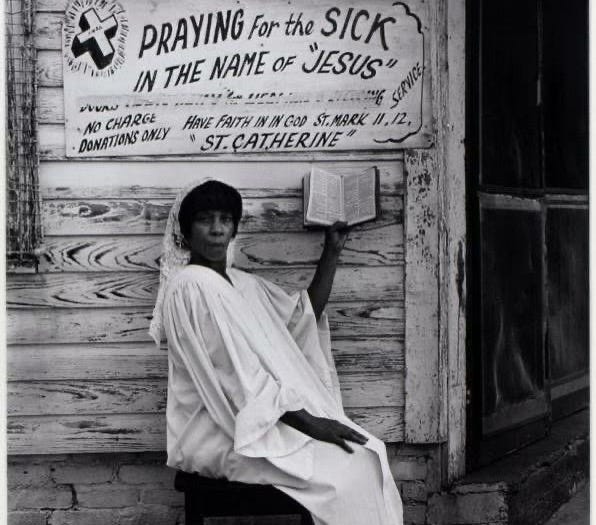
There is no such thing as pure culture. Anywhere in the world. When human beings from different cultures, religions, and backgrounds encounter one another, their traditions inevitably influence, intersect, and blend. New Orleans is an epicenter of this cultural fusion. Our Creole languages, gumbo, second lines, jazz, and Hoodoo all reflect generations of cultural exchange, adaptation, and innovation.
Yet, during October, Hoodoo Heritage Month, I’ve noticed that many (emerging) practitioners refuse to acknowledge the syncretic nature of the very spiritual practice they seek to reclaim.
Some eagerly embrace Hoodoo practices they’ve encountered online, emphasizing their connections to Indigenous and African spiritual traditions. But when the conversation turns to Christianity, a cognitive disconnect emerges.
The problem? Christianity is deeply embedded in the history and practice of Hoodoo.
I understand the resistance. When you witness corrupt pastors and examine how white Christian institutions and interpretations of scripture have justified enslavement, colonialism, and contemporary violence against Palestinians, skepticism is warranted.
Then you begin researching. You discover Ethiopia’s ancient Christian traditions, the history of biblical translations, and the political decisions that shaped the versions of scripture we encounter today. Suddenly, the Christianity you’ve inherited begins to look different from the Christianity you thought you knew.
Congratulations. You’re deconstructing in real time.
But here’s the thing: Your ancestors still incorporated elements of Christianity into their Hoodoo practices.
So, do you trust your ancestors?
I trust mine.
I trust them to have wrestled with harmful doctrines, challenged what did not serve them, and preserved the beliefs and practices they believed would sustain and uplift future generations. I trust them to have combined ancestral wisdom with new knowledge, adapting their spiritual practices to the circumstances of their lives.
My ancestors didn’t all practice the same Hoodoo because they developed across different contexts.
My granny, my mother’s mother, is a native New Orleanian and Southern Baptist. My mémère, my stepfather’s mother, was a Haitian woman educated in Catholic boarding schools. And my biological father’s mother was an Indigenous woman who married a Black man whose ancestral origins remain unknown to me. They attended church throughout their marriage, until his death.
Their practices differed because their families developed distinct traditions across geographic locations, cultural environments, and religious contexts.
And I am the descendant of those traditions. As their grandchild, I draw from their teachings, beliefs, and spiritual practices to create something that reflects my own experiences and understanding of the world. One day, my daughter will inherit those traditions, too. And I hope she feels empowered to question, explore, adapt, and build upon them, just as the women before her did.
If I refused to reject the practices rooted in Christianity, I would only be getting part of the story.
You have to do your own research.
You’ll notice I deliberately excluded specific examples of my family’s Hoodoo practices from the previous section.
That wasn’t selfishness; it was intentional. I want you to be curious.
When I began my journey (which is ever evolving), a good friend challenged me to do exactly that. I realized she couldn’t hold my hand.
My practices while similar to hers, were not hers. That’s because my ancestry is not her. And your ancestry is not mine. My family’s history, geographic roots, religious influences, and spiritual traditions are not interchangeable with yours.
You have to do the internal reflection, research, and introspection necessary to discover your own path. As always, I suggest beginning with books. Two foundational texts worth exploring are Jambalaya and Of the Calabash.
But don’t read these books like novels. Read them the way you history teacher made you read primary sources.
Grab your highlighter. Annotate the margins. Write on some sticky note. Then close the book.
Lie down. Close your eyes. Reflect on what you’ve read. Consider what you remember from your childhood, your elders, your family gatherings, and the traditions you witnessed long before you had the vocabulary to name them.
That process can help you discover how you commune with your ancestors, which spiritual practices resonate with you, and how you understand your place in a much larger story.
Your practice should not simply be a collection of rituals someone on the internet told you to perform. It should reflect an intentional relationship with your history, your ancestors, and yourself.
You cannot honor your ancestors selectively.
Above all else, respect your ancestors. Respect the fullness of their histories. Respect the complexity of their beliefs. Respect the religious traditions they embraced, questioned, transformed, and passed down.
You do not have to practice Christianity. You do not have to accept every doctrine your ancestors accepted. And you certainly do not have to ignore the harm perpetuated in Christianity’s name.
But there is a difference between critically examining a tradition and belittling the people who practiced it. The same ones you turn around asking for help. You cannot claim to trust your ancestors’ spiritual wisdom while dismissing the very beliefs they incorporated into their spiritual lives.
These people made you possible. They survived circumstances we will never fully comprehend, made decisions with knowledge we may never recover, and built traditions that continue to shape your existence.
You are allowed to disagree with them. But don’t confuse deconstruction with disrespect.
And don’t mistake rejecting Christianity for reclaiming an automatically “more authentic” form of Hoodoo.
They left you a foundation. What you build upon it is your responsibility.
Julienne Louis-Anderson is a Black American daughter of the Deep South. She writes about the intersection of Black womanhood, with Black culture and Black education. She can be found on social media @juliennelouisanderson.
For just $5 a month, you’re directly investing in Black writers, Black ideas, and the future of independent Black media. Every subscription helps us commission original stories, platform new voices, and continue building E.N.D. into a living hub for revolutionary thought, culture, education, and community.
Thank you for helping us build something that belongs to us.
We can respect our ancestors without respecting the systems that partake in .
I haven’t read the article yet but on on title alone, this truth needs to be said way louder!!!! 🗣️🗣️🗣️🗣️