

In this 3 part series, we examine the complicated relationship between African football, Black identity, and Pan-African solidarity. From AFCON’s political history and growing commercial influence to the inequalities facing women’s football, the series explores what African unity really means, who benefits from it, and why celebrating the continent’s achievements must also mean holding its institutions accountable.
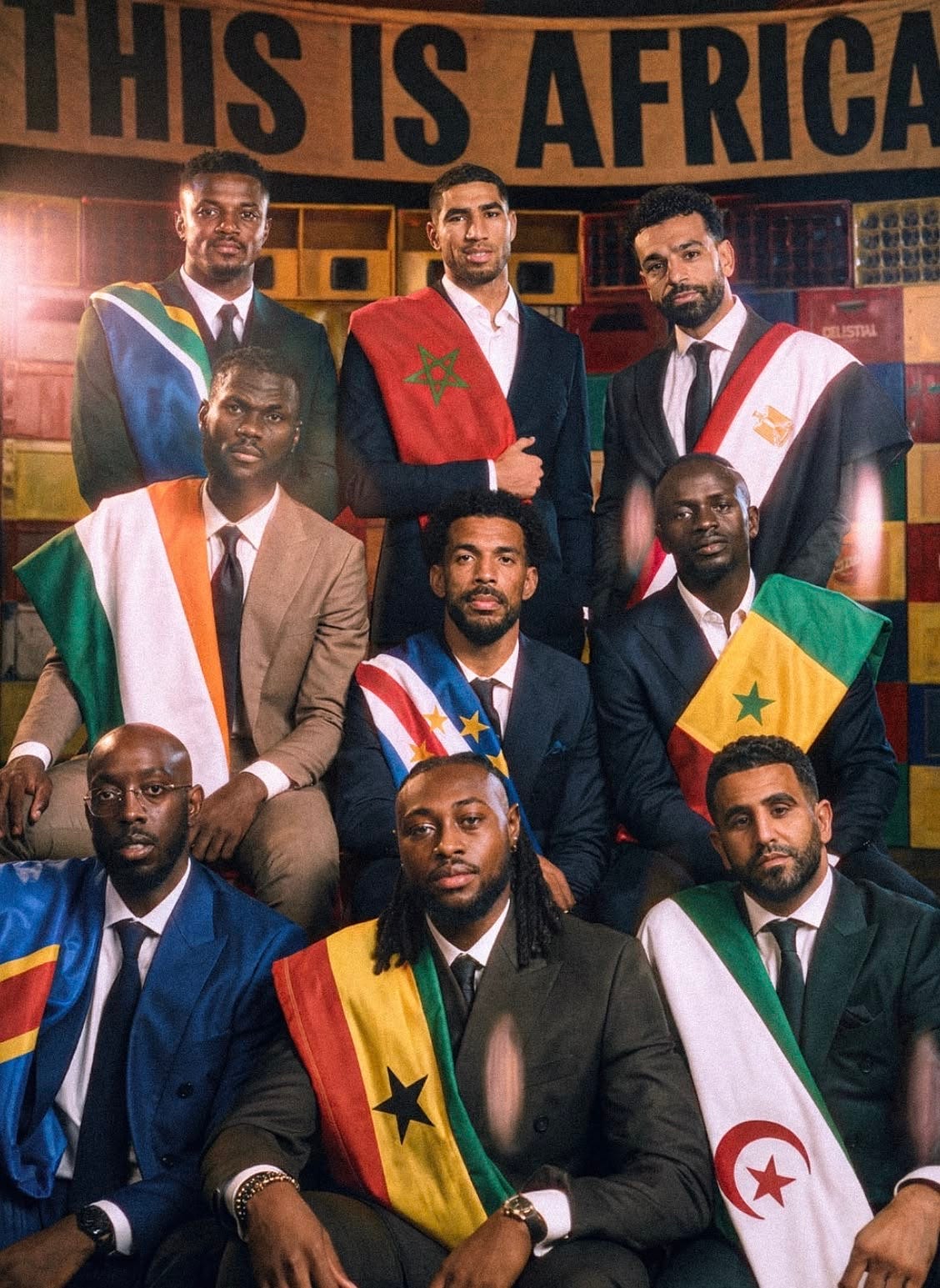
We’re dealing with 54 African football associations, a continent with an extraordinarily complicated history, and millions of people who will happily preach Pan-African unity until their country loses a match.
That’s also what makes AFCON so fascinating.
AFCON is one of the Blackest sporting events on Earth, although even that description comes with questions. There’s the football, obviously. But there’s also the fashion, the music, the flags, the diaspora claiming countries they haven’t visited in years, and the national rivalries that can turn a referee’s decision into a continental argument. Africa isn’t exclusively Black, Blackness isn’t experienced uniformly across the continent, and being African doesn’t automatically mean identifying with the same politics, histories, or traditions.
If anything, AFCON reminds us how complicated this whole African solidarity thing truly is. We love the idea of a united Africa. We celebrate our collective excellence, complain about how the West portrays us, and insist that Africans need to support one another. Beautiful sentiments, really. But beneath all that togetherness are competing national interests, regional prejudices, economic inequalities, and a long history of people disagreeing about what African unity should actually look like.
Which brings me to the heart of this essay: African unity means very little if the institutions celebrating it continue to reproduce the very inequalities that divide the continent.
The revolutionary thinker Frantz Fanon (one of my favorite intellectual troublemakers, personally) had quite a bit to say about this.
In his 1961 book The Wretched of the Earth, Fanon examined how the promise of liberation could become compromised by nationalism, class interests, and the political ambitions of newly empowered elites. In the chapter The Pitfalls of National Consciousness, he observed:
“Between resounding assertions of the unity of the continent and this behaviour of the masses which has its inspiration in their leaders, many different attitudes may be traced.”
Proclaiming African unity is one thing. Practicing it when political interests, national loyalties, and economic power are involved? That’s an entirely different assignment.
Fanon wasn’t criticizing people for loving their countries. His concern was what happened when the language of liberation became a convenient accessory for those already positioned to benefit from independence. A continent could celebrate its freedom while its institutions continued reproducing some of the very inequalities it claimed to have overcome.
More than six decades later, African football is navigating its own version of that uncomfortable conversation.

The 2025 AFCON final between Senegal and Morocco offered a public example.
On January 18, 2026, Senegal defeated Morocco 1–0 in extra time after a turbulent final in Rabat. Following a disallowed Senegalese goal and a controversial VAR-awarded penalty in Morocco’s favor, Senegal’s players temporarily walked off the pitch in protest, believing the officiating had unfairly favored the host nation. Senegal ended up returning to the pitch and secured the victory.
You would think that was the end of it. Apparently not...
In March, the Confederation of African Football (CAF) overturned the result, ruling that Senegal’s walkout violated tournament regulations and awarding Morocco a 3–0 victory. Senegal challenged the decision at the Court of Arbitration for Sport, which heard the appeal on October 8. According to Reuters, a ruling is expected by the end of November.
Neither the refereeing debacle nor CAF’s ruling necessarily proves regional favoritism. But the accusations alone reveal something uncomfortable about African football: for an institution that preaches continental unity, it doesn’t take much for everyone to start questioning whose interests are actually being protected.
Can you blame them?
When a governing body overturns the result of a continental championship months after the final whistle, people are going to have questions. Plenty of them. Senegal’s walkout was as controversial as the decision to award Morocco a victory after the match had been played to completion. The rules matter, of course... But so does the public’s confidence that those rules are being applied fairly, regardless of which country is involved.
That’s where CAF has an issue (well, one of many). You cannot spend an entire tournament celebrating African excellence, solidarity, and togetherness, only to expect everyone to accept a contentious ruling without questioning the institution behind it. Continental pride is wonderful. Institutional accountability? Even better.
And the irony becomes even more apparent when you remember why AFCON exists in the first place.
The inaugural tournament took place in Sudan in 1957, when much of Africa remained under European colonial rule. South Africa was excluded after refusing to field a multiracial team under apartheid. Imagine that. Before AFCON became the continental spectacle we know today, African football was already taking a political stand against racial exclusion and asserting the right of African nations to represent themselves on their own terms. God, sports really are just so political.
African solidarity was never supposed to be decorative. It emerged from struggles against colonial domination, racial hierarchy, and political exclusion. Supporting African football was part of a broader insistence that African people deserved authority over their own futures.
Whether they’re watching from Dakar, London, Paris, or New York, supporters gather around teams that represent childhood memories, inherited traditions, and sometimes places they know primarily through the people who raised them. National jerseys become expressions of belonging, while watch parties transform ordinary spaces into extensions of home. There’s something extraordinary about a tournament that can bring generations and communities together across thousands of miles.
That connection is real. It deserves to be revered.
But the institutions benefiting from it should be expected to honor the same principles of inclusion and self-determination that made African football politically consequential in the first place.
That’s why the entire Senegal-Morocco fiasco pissed me off so much.
As a Sierra Leonean-American, my love for football has always been intertwined with my love for African culture. Watching African nations compete, seeing our flags, hearing our music, and witnessing our talent on display is something I take immense pride in. It’s about time Africa received its flowers.
Senegal won that final on the pitch. Point blank. They deserved their victory. Yeah, walking off the field warrants consequences (oh gee golly, I wonder why they did that), overturning the result months later left quite a bitter taste in my mouth. Especially when you consider the longstanding tensions surrounding anti-Blackness in North Africa.
I don’t believe the fiasco overshadowed the football. If anything, it forced conversations we’ve spent far too long avoiding--power, race, institutional accountability, and what coming together actually looks like when national interests collide.
Increasingly, there’s a great deal of money involved. According to CAF’s 2025–26 budget, the organization projected approximately $312.85 million in revenue. African football is attracting greater commercial interest, but who is benefiting from all this attention?
African expression deserves its place on the world stage. But applause doesn’t pay for training facilities, and trending on TikTok won’t build a football academy.
Fanon had a name for the political class that could inherit the privileges of colonialism without transforming the structures beneath them: the national bourgeoisie.
In The Wretched of the Earth, he argued that some postcolonial elites were more concerned with occupying the positions formerly held by Europeans than building an economy that served ordinary people. The personnel changed. The distribution of power? Not nearly enough.
CAF already has mechanisms intended to support football development. Demonstrating that impact, however, is a whole different thing.
Pan-African solidarity should have a paper trail. If millions are being generated in the name of African football, we should be able to follow where that money goes, who receives it, and what it accomplishes.
Because I want better for Africa. I want our athletes, artists, and communities to receive the love and resources they deserve. I want us to celebrate our achievements without pretending our institutions are above criticism. And I want African unity to mean something beyond a beautiful sentiment we dust off every tournament season.
But if we’re going to question who benefits from African football’s growing success, there’s one rather glaring omission we need to address.
What about the women?
*Maybe later, we can add “Please find part two, here”*
Bio - Meena Jalloh is an NYC-based cultural journalist, whose work explores the intersections of Blackness, gender, and storytelling.
For just $5 a month, you’re directly investing in Black writers, Black ideas, and the future of independent Black media. Every subscription helps us commission original stories, platform new voices, and continue building E.N.D. into a living hub for revolutionary thought, culture, education, and community.
Thank you for helping us build something that belongs to us.